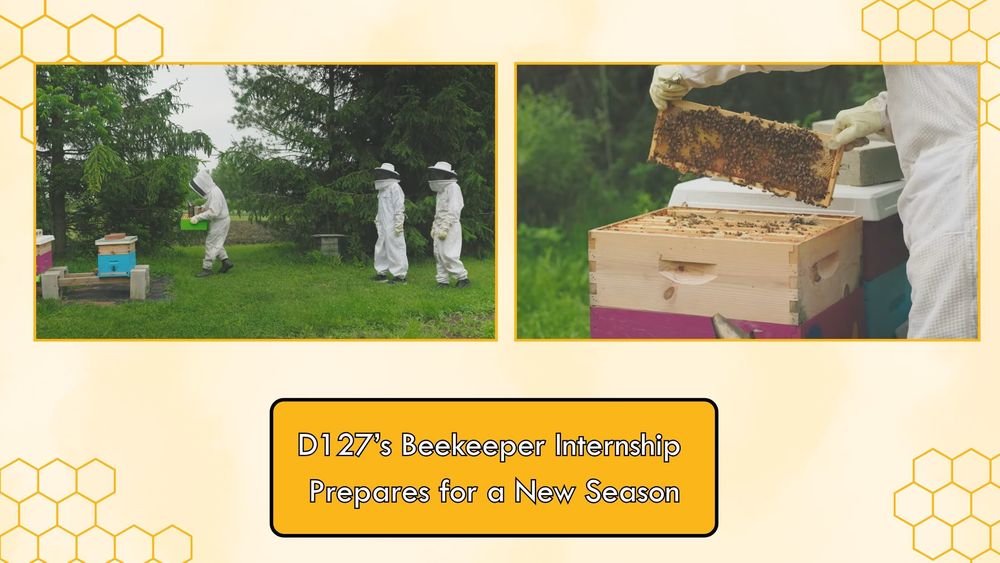
While snow rests on the fields at Liberty Prairie Farm, the bees are clustered tightly inside their hives, conserving heat, protecting their queen, and waiting for spring.
At Grayslake District 127, preparations for summer are already underway.
Career and Technical Education (CTE) teacher and Liberty Prairie Farm Director Jeff Miller is preparing to interview students for one of D127’s most unique hands-on learning opportunities: the Beekeeper Internship, where students manage their own hives.
“Winter is when the planning happens,” Miller said. “The bees are surviving the cold, and we’re repairing equipment, reviewing hive data, and getting ready for the next season. Soon, we’ll select the next interns to take on that responsibility.”
Limited to two students each year due to available hives and protective equipment, the internship runs primarily during the summer, beginning shortly after school ends and concluding before the new year begins.
Each intern is assigned their own hive.
They collaborate on challenges, but they are accountable for monitoring the health, productivity, and overall well-being of their colony.
During weekly sessions, interns will:
Inspect hive health and queen activity
Monitor larvae development and egg-laying
Evaluate honey production and hive space
Recommend interventions if a colony is struggling
Early days focus on learning to use protective gear properly and handle equipment carefully. Soon after, students are pulling frames, inspecting thousands of bees, and thinking critically about hive management decisions.
“It’s real responsibility,” Miller said. “They’re not observing, they’re doing.”
The internship extends beyond science. Students track startup costs, maintenance expenses, and honey sales through simple spreadsheets. They learn about profit and loss, discuss marketing strategies, and examine how products move from hive to customer.
Honey harvested at Liberty Prairie Farm is sold in the farm store and recently expanded to the Dunn Museum gift shop as part of its For the Love of Pollinators exhibit. Interns assist in extracting and bottling honey, and even take home a portion of what they help produce.
Through the experience, students see the full cycle of entrepreneurship: production, bookkeeping, marketing, and sales, a true example of partnership between classroom learning and the community.
“It’s biology, agriculture, and business all working together,” Miller said.
Though bees are less visible in February, farm work continues year-round. Winter is spent repairing equipment, maintaining hives, and planning for the season ahead, reinforcing that successful summer harvests begin with careful preparation.
As spring approaches, Miller will begin interviewing students for the 2026 Beekeeper Internship. Current interns may return, and new students interested in agriculture, sustainability, or entrepreneurship are encouraged to apply.
At Grayslake District 127, we empower all learners to launch their futures through relevant, engaging, authentic learning, and sometimes, that learning begins with a single hive.